


01
02
03
04
05
04
05
Define:
Pricing Guardrails
-
What pricing, profitability and risk boundaries should you set?
Cost:
Funding Economics
-
What term-structure mapping and granular risk economics determine the transaction cost?
PSS:
Customer Value
-
What is the customer willing to pay?
Market:
Competitive Intelligence
-
What will the market bear?
ALM:
Balance Sheet Impact
-
What is the balance-sheet impact?
-
What pricing, profitability and risk boundaries should you set?
-
What term-structure mapping and granular risk economics determine the transaction cost?
-
What is the customer willing to pay?
-
What will the market bear?
-
What is the balance-sheet impact?
balance sheet risk
Connect Transaction Pricing to the Balance Sheet.
Every pricing decision changes the shape of the balance sheet. BBA connects pricing decisions to their balance-sheet impact, helping you identify mismatch and asymmetric rate sensitivity before it becomes embedded in the portfolio.
1. ASYMMETRIC BALANCE-SHEET RISK
-
The risk you don't see in the base case.
-
A balance sheet can appear broadly matched today, yet respond very differently when interest rates change.
2. MANAGE RISK WHILE BOOKING DEALS
-
De-risk the balance sheet at the source.
-
Incorporate funding cost, customer sensitivity, market conditions and balance-sheet impact into pricing decisions before the deal is booked.
3. HEDGING COST & RESIDUAL RISK
-
Swaps manage exposure, but they don't remove the economics of creating it.
-
Reduce hedging costs, chip away at basis risk and residual exposure before deciding how much risk to hedge.
4. INTEGRATED ALM
-
See the impact before it becomes embedded.
-
Connect pricing and origination decisions directly to ALM to understand their impact on NIM, duration, EVE and capital.
The Outcome
Price better. Convert more. De-risk the balance sheet. Improve NIM.
Price better. Convert more. De-risk the balance sheet. Improve NIM.
What Our Clients Say
"BBA FinTech's integrated platform is a generational leap from the fragmented ALM systems we were used to. The ability to unify IRRBB, liquidity, and ICAAP in one place, at a cost that was a fraction of what other vendors quoted, has transformed our approach to balance sheet management management."
- Ahmad Safarov
Head of ALM


"BBA FinTech's multi-agent pricing model drove measurable value for nearly 70% of our client base — proving its effectiveness even with hard-to-reach segments like new customers and previously inactive clients."
- Peter Blazai
Head of Credit Risk
"The integration of pricing, risk, and capital management gave our board the confidence to make faster, more informed decisions."
- VSM Raju
Chief Financial Officer

ALM INTELLIGENCE

balance-sheet & NIM sensitivity monitoring


On-demand features
Essential but not mandatory to run ALM.

IFRS 9 Impairment
🚩 Manual, siloed impairment processes delay financial close and expose your institution to audit and regulatory scrutiny.
📊 PBI Dashboard Included

Credit Unexpected Loss & Scenario-Based Stress Testing
📉 Traditional credit risk models fail to capture portfolio concentration and systemic risk correlations — a regulatory requirement under Basel III/IV — leaving your capital buffers exposed to unexpected losses.
📊 PBI Dashboard Included

Risk-based Capitalization & ICAAP
🏦 Fragmented risk models and manual RWA calculations create inefficiencies and blind spots — leaving your ICAAP submissions vulnerable to regulatory challenge.
📊 PBI Dashboard Included

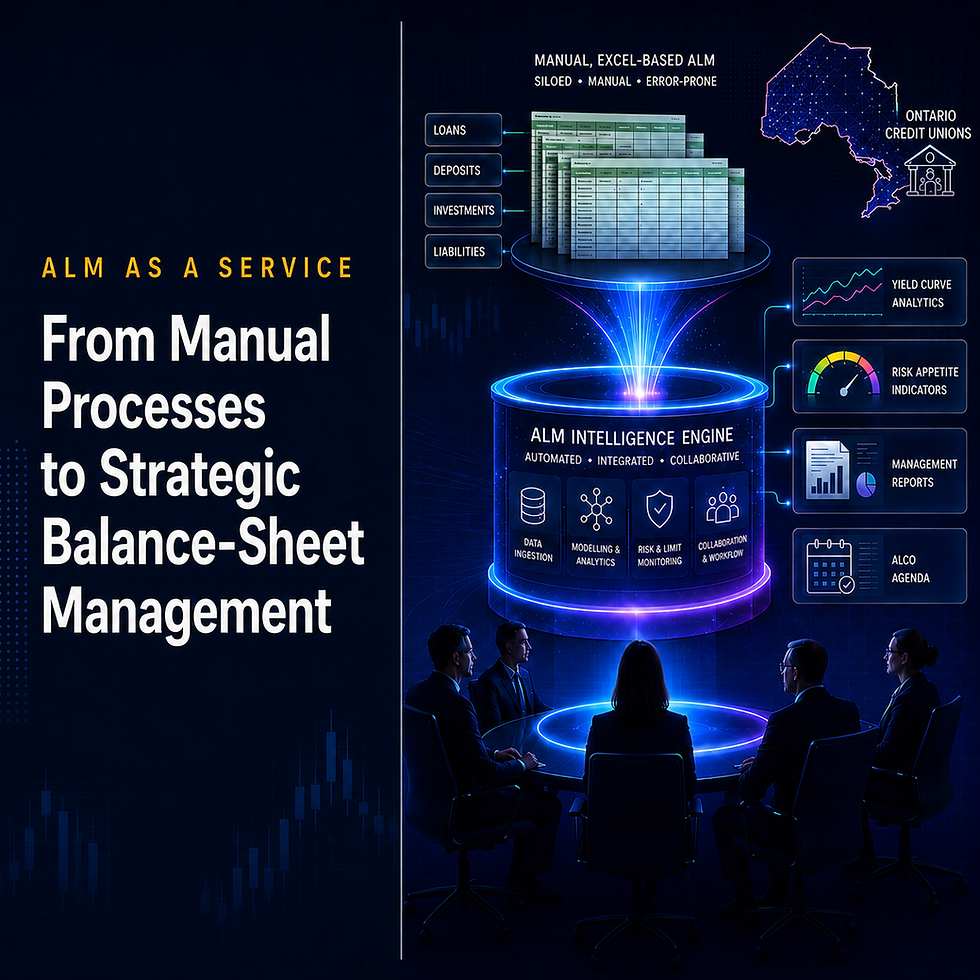
ALM Advisory as a Service
Use case 1
Transforming ALM from a manual process into a strategic balance-sheet capability.
business value
-
Automated data ingestion and validation
-
Advanced ALM modelling and scenario analysis
-
Faster, more reliable management and ALCO reporting
-
Improved visibility into interest-rate and balance-sheet risk
-
Stronger collaboration across Treasury, Finance and Risk
Business imperative
-
Replace manual, error-prone Excel-based ALM processes
-
Establish an automated and integrated ALM operating model
-
Connect ALM metrics and limits with the risk appetite framework
-
Strengthen interest-rate and balance-sheet risk management
-
Improve collaboration across Treasury, Finance, Risk and executive management
-
Establish a structured, forward-looking ALCO agenda and governance process
Use case 2
Validation as a Service
Independent assurance over vendor ALM models and IRRBB measurement
business value
-
Validated EaR, EVAR and interest-rate shock calculations
-
Identified aggressive assumptions and calculation errors
-
Delivered targeted recommendations for model improvement
Business imperative
-
Address uncertainty in IRRBB capital-allocation methodology
-
Reduce inconsistent application and potential regulatory arbitrage
-
Strengthen model accuracy, governance and regulatory confidence

contact us
Collaboration

